For immediate release
Report: American steelmakers falling short on clean steel investment
New market entrants Nippon Steel and Hyundai Steel add new climate risks and opportunities, according to global watchdog group
Ariana Criste, Deputy Communications Director
Washington, DC — U.S. steelmakers Cleveland-Cliffs and U. S. Steel received failing scores in a new global assessment of steel industry transition readiness, according to an inaugural report released today by SteelWatch, an international watchdog organization.
The SteelWatch Corporate Scorecard (http://www.steelwatch.org/scorecard) evaluated 18 steelmakers across 11 of the world’s largest steel-producing countries based on publicly available disclosures, including annual and financial reports published in 2025 covering fiscal year 2024. The assessment measures companies’ progress toward near-zero-emissions steel production across categories such as emissions targets, investment in low-emissions technologies, coal phase-out planning, and social and environmental governance.
Across the companies assessed, the report finds that most steelmakers remain heavily reliant on coal-based blast furnace production and have yet to incorporate near-zero-emissions ironmaking technologies into core business strategies.
Among U.S. companies, Cleveland-Cliffs and U. S. Steel received total scores of 29.4 and 28.3 out of 100, respectively. Both companies have reduced overall coal consumption in recent years, but continue to rely primarily on blast furnace production. Each has also announced plans to invest hundreds of millions of dollars in the relining of aging blast furnaces at Cleveland Cliffs' Burns Harbor and Middletown Works and U. S. Steel’s Gary Works.
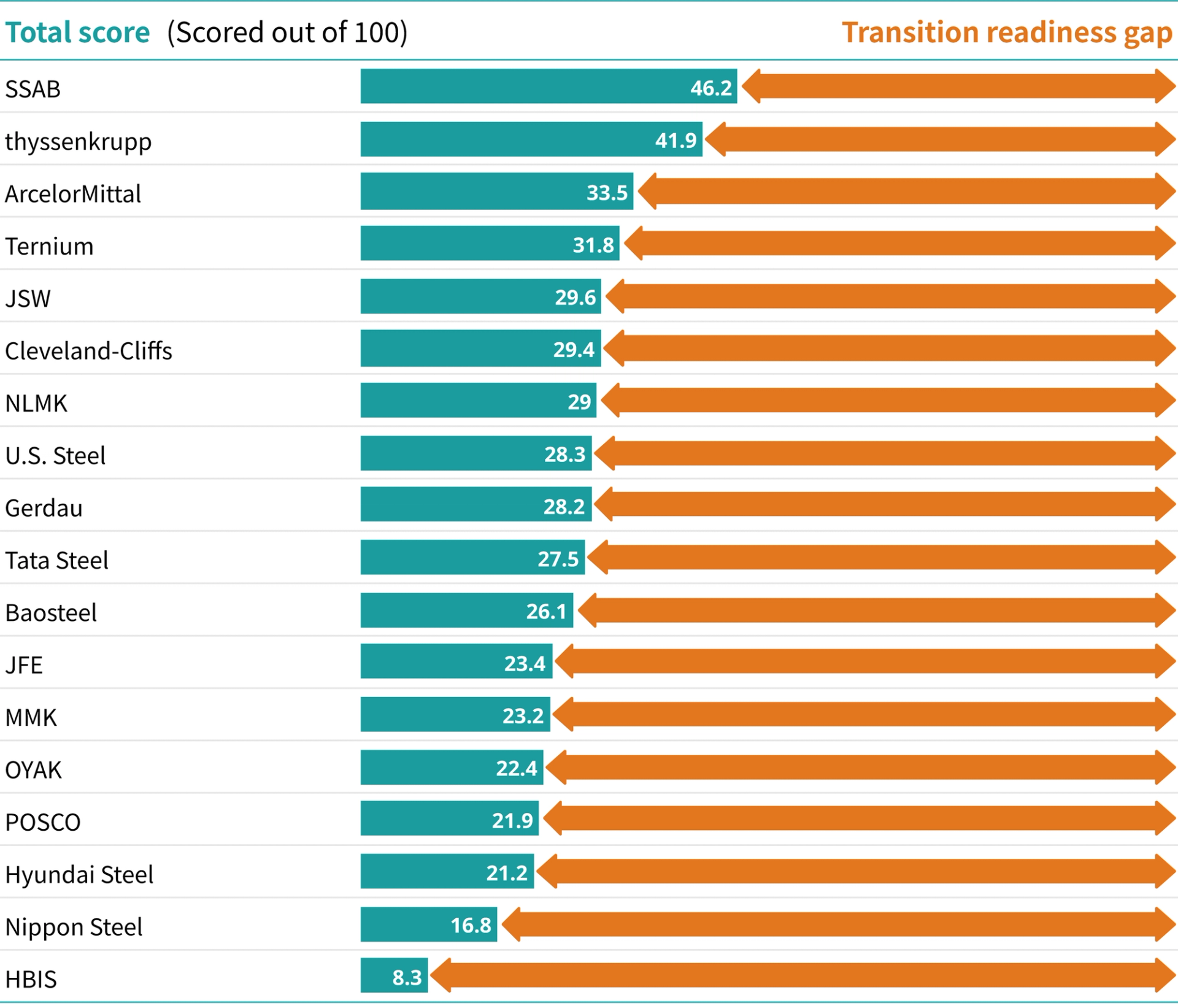
Above: Global steel companies ranked by transition readiness (Credit: SteelWatch)
Continued investment in blast furnace relining could extend reliance on coal-based steel production well into the 2040s, delaying the shift to next-generation ironmaking technologies.
“Relining a blast furnace keeps a plant operating, but it doesn’t secure a community’s future in the steel industry,” said Ariana Criste, Deputy Communications Director at Industrious Labs. “Across the U.S. steel industry, we’re seeing two different transitions unfold: in some places, companies are investing in next-generation ironmaking, and in others, they’re extending the life of older coal-based production. Decisions like this will shape which communities are positioned for the future of steel, and which are saddled with its past."
Nippon Steel, which recently acquired U. S. Steel, ranked near the bottom of the companies assessed, receiving a total score of 16.8 out of 100.
The report notes that Nippon Steel operates one of the largest blast furnace fleets among the companies evaluated and remains heavily reliant on coal-based steel production. The company has confirmed plans to reline Blast Furnace No. 14 at Gary Works, while details on potential investments in near-zero-emissions ironmaking technologies remain limited.
“While U. S. Steel’s latest announcements promise transformation, its acquisition by one of the most coal-committed steelmakers in the world presents substantial risks of complacency,” said Roger Smith, Asia Lead at SteelWatch. “Details of Nippon Steel’s planned investments in U. S. Steel remain scarce and fulfilling the promise of transformation means putting the majority into near-zero-emissions iron and steel technology rather than keeping coal-based production on life support. Nippon Steel should engage in dialogue with key stakeholders, including communities and local officials near the plants, over its plans — as they have serious implications for public health, long-term employment and a stable climate.
Another steelmaker expanding its presence in the U.S., Hyundai Steel, also ranked near the bottom of the assessment due to limited evidence of structural progress toward phasing out coal and incomplete disclosure of transition data. However, the company recently announced plans to build an integrated DRI-EAF facility in Louisiana, which the report identifies as a potential step toward lower-emissions steel production and a higher score in future years, if paired with renewable energy and green hydrogen.
“Hyundai Steel still has a long way to go to clean up its global footprint,” said Matthew Groch, Senior Director at Mighty Earth. “Its proposed Louisiana mill could become one of the first coal-free primary steel plants in the U.S., but calling it ‘green’ hinges on whether Hyundai actually delivers on its promises for renewable energy and truly green hydrogen. Without that, it risks being another steel project that talks climate progress while locking in fossil fuel dependence.”
Website: http://www.steelwatch.org/scorecard
###
About SteelWatch: SteelWatch is an international campaign organization that brings “climate urgency” to the sector through the publication of data, strengthening of civil society voices, scrutiny of corporate performance, and direct challenges to steel companies to shift their investments faster.