
Overview
Nearly every factory, from those making paper towels to cement and glass to canning vegetables, relies on process heat — and currently, polluting, fossil-fueled combustion boilers supply most of it. The majority of emissions from the manufacturing sector come from burning fossil fuels for heat. Boilers providing low-temperature heat — which have the most readily and commercially available clean alternatives — account for 171 million metric tons of CO2 alone.
We have a historic opportunity to clean up manufacturing by transitioning to zero-emission energy solutions that are available today.
Industrial heat pumps, electric boilers, and thermal batteries are cleaner, more efficient electric alternatives. Geothermal systems can also unlock heat from the earth to power manufacturing processes. By weaning our reliance on burning fossil fuels for industrial heat, we can rapidly decarbonize this sector, cut U.S. industrial climate emissions, and save tens of thousands of lives.
California has more industrial boilers than any other state, and manufacturing is the backbone of its economy, employing over 1.2 million workers and contributing 10% of the state's GDP. This sector produces the essential goods we use every day, from bread and coffee to cement, glass bottles, and medicine. However, the scale of this sector also makes it a major source of climate and air pollution.
California's industrial sector accounts for about 20% of the state's climate-warming emissions — the highest polluting sector after transportation. And the vast majority of energy used by the over 36,000 manufacturing facilities relies on fossil fuels. Burning these fuels emits health-harming air pollution like nitrogen oxides (NOx), sulfur dioxide (SO2), and particulate matter (PM) that drives smog and is linked to increased rates of respiratory illnesses, heart disease, and premature death.
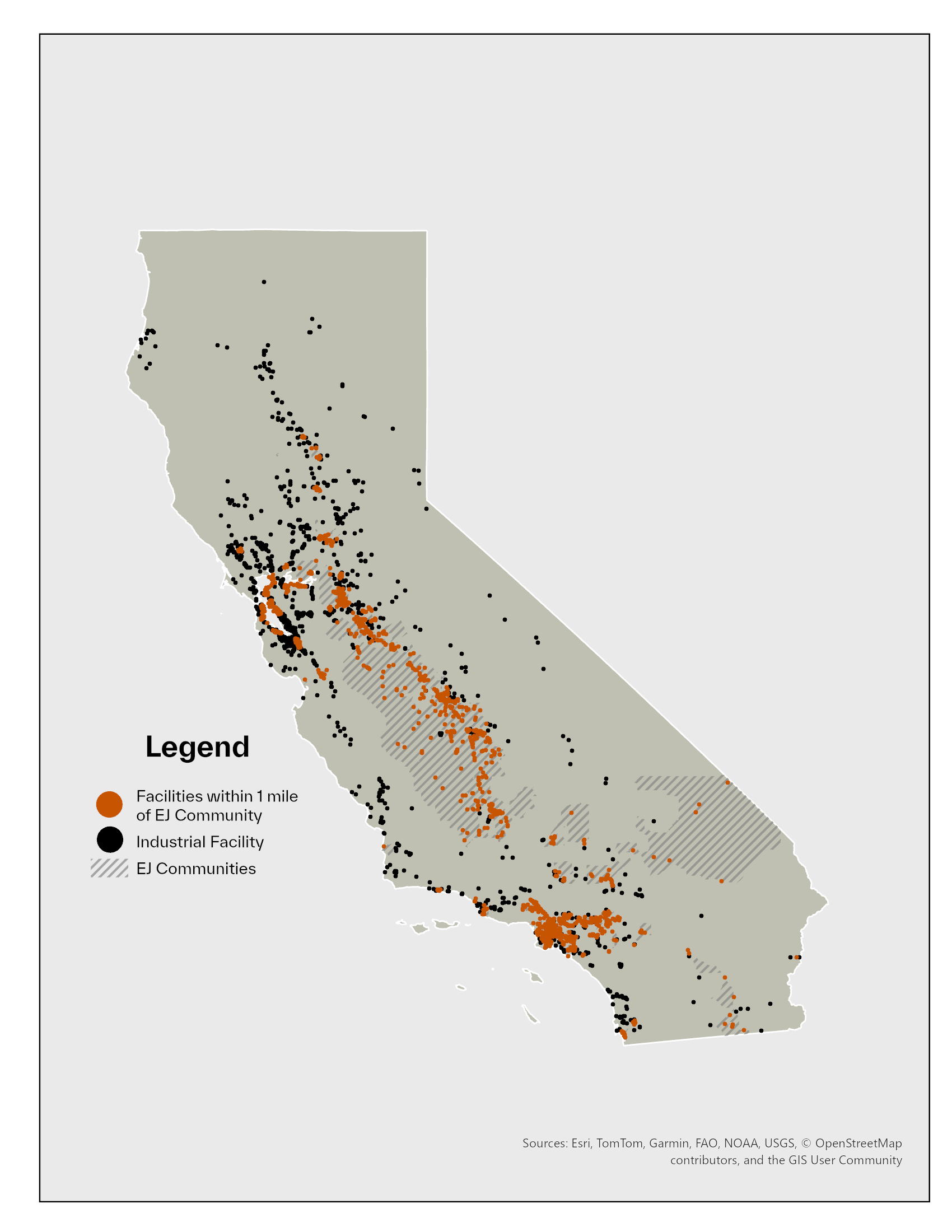
This pollution disproportionately harms low-income communities and communities of color in California, often clustered in regions like the San Joaquin Valley, San Francisco Bay Area, and the Los Angeles basin.
Map of industrial manufacturing facilities within one mile of environmental justice communities
Solutions
The pathway to a modern, clean manufacturing sector is clear. Investing in existing zero-emissions technologies to replace gas-fired equipment can achieve a triple win:
- Cleaner air & climate: According to a recent report from the American Lung Association, electrifying process heat from key industrial sectors could avoid over 77,000 early deaths and over 33.2 million asthma attacks by 2050 — delivering an estimated $1 trillion in public health benefits nationwide.
- Grid affordability & resiliency: Thermal batteries can soak up cheap, clean renewable power and relieve peak demand grid stress. By updating industrial electric rates to better reflect the cost of cheap, renewable electricity, we can leverage our factories as a vast network of large, load-shifting assets that increase the reliability of the electric grid and drive down the costs of our energy system for all ratepayers.
- Good jobs & economic security: Modernizing aging facilities will help secure our manufacturing base as a long-term economic driver and also create new, high-skilled jobs to install new equipment and retrofit existing facilities and make our manufacturing sector more competitive.
Our work
California can slash air pollution in overburdened communities and tackle a dramatic source of statewide climate emissions by cleaning up our manufacturing sector.

Secure funding to support manufacturers
Public investment is necessary to support early adopters of clean industrial heat by de-risking investments that will help transform the market. Alongside Earthjustice and a broad coalition of community, business, and labor partners, we passed Assembly Bill 1280 (Garcia). The new law expands access to funding for manufacturers to adopt zero-emission technologies while strengthening community benefits and labor standards to help to retain and grow California’s skilled workforce in the clean manufacturing economy.
- California passes law to help modernize manufacturing in a win for jobs and clean air. (Industrious Labs and Earthjustice)
- Modernizing California’s manufacturing sector is a win for climate, economy. (Sacramento Bee)

Modernize industrial electricity rates
California regulators can implement smart rate structures that incentivize manufacturers to take advantage of abundant and low-cost renewable energy, helping to accelerate adoption of electric, zero emissions technology and to mitigate the growing costs of California’s electricity grid. Read about policy and rate reforms California regulators can adopt to unlock industrial electrification.

Pass life-saving regulations
Zero emissions standards for industrial heating equipment are essential for cutting health-harming pollution and protecting public health. In 2024, we secured two landmark victories in Southern California with the passage of South Coast Air Quality Management District (SCAQMD) zero emissions Rule 1153.1 for commercial ovens and Rule 1146.2, the nation’s first regulations to phase out pollution from industrial boilers and water heaters, which will replace over a million pieces of gas-powered equipment and cut smog-forming NOx pollution by 5.6 tons per day, equivalent to half of all passenger cars on the road in the region.
Battle over industrial boilers gets a new tool that you can use to combat pollution. (LAist)
Court upholds landmark rule to advance zero-emissions water heaters & boilers. (Earthjustice)
Southern California passes landmark rule to electrify water heaters & boilers (Earthjustice)
Read more
Blogs and news
- 07.02.2026

Press release: Ninth Circuit rejects industry challenge to SoCal clean air rule for boilers, water heaters
- 05.06.2026
- 03.17.2026

Teresa Cheng speaks in support of SB 943 at the State Senate
Skyrocketing electricity rates are one of the biggest barriers keeping California manufacturers from switching to clean equipment. In testimony before the California Senate, Teresa Cheng made the case for how updating electricity rate structures through Senate Bill 943 could give manufacturers a sustainable pathway to operate clean equipment in California.
- 12.16.2025
- 10.07.2025

Press release: California passes law to help modernize manufacturing in a win for jobs and clean air
- 09.24.2025

Teresa Cheng joins Volts podcast: How to clean up beer brewing and other low-temperature industries
- 08.22.2025
- 08.11.2025


Reports, fact sheets, and more

Report: Unlocking industrial electrification in California: Strategies for electricity rate design and policy reform
A new report finds California can greatly increase its ability to achieve cleaner air, lower utility bills, and decrease climate emissions by modernizing electricity rate design for manufacturers.

Fact sheet: Unlocking industrial electrification in California
A new report finds California can greatly increase its ability to achieve cleaner air, lower utility bills, and decrease climate emissions by modernizing electricity rate design for manufacturers.